
- Mirror attacker behavior: run a broad hunter pass for suspected vulnerabilities, then use separate verifier agents whose only job is to disprove each finding before you spend time proving it.
- Do not let a hunter agent grade its own work; isolate verification and parallelize hunters for coverage and speed when auditing a real codebase.
- Use five practical questions as the audit frame: broken authentication, cross-user data exposure, leaked secrets, prompt injection against AI features, and cost/availability abuse.
Latest indexed videos (6)
Trend radar (14d)
Open trend radar
Claude
10ch · 21v
AI Agents
8ch · 10v
Anthropic
7ch · 11v
Claude Code
6ch · 14v
Coding Agents
6ch · 12v
OpenAI
5ch · 15v
AI coding agents
5ch · 6v
TypeScript
4ch · 7v
OpenRouter
4ch · 4v
Evals
3ch · 9v
Jev
3ch · 6v
Codex
3ch · 6v
LangGraph
3ch · 5v
JavaScript
3ch · 4v
Fable 5.2
3ch · 4v
subagents
3ch · 3v

- Treat agent config as executable surface: settings files, hooks, and MCP definitions can trigger downloads or shell commands the moment a session starts, so review them like code before cloning or opening a repo.
- Installing packages inside an agent session inherits the agent's environment — run installs in a sandbox or container without ambient cloud/API credentials mounted.
- Conversation transcripts and logs are de facto credential stores; avoid pasting env files or tokens into chat, and prune history rather than assuming it is private.
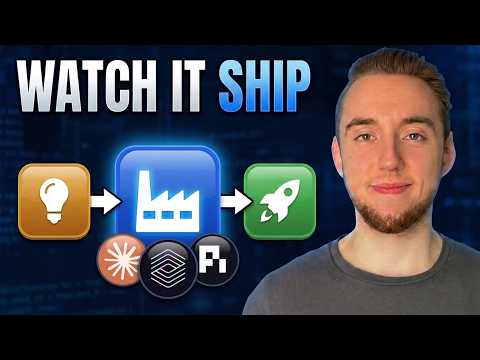
- Treat the AI software factory as an orchestration layer: intake, planning, task decomposition, implementation, validation, and escalation are distinct stages rather than one monolithic prompt.
- Break work into small independently checkable units so coding agents can build and verify each piece before integration.
- Automated checks are the control plane for autonomy; without verification gates, end-to-end generation is just faster rework.

- Scope tool credentials per action and environment; an agent should never inherit broad production database privileges just to complete a task.
- Insert human approval before irreversible or high-blast-radius actions, not merely after the agent proposes them.
- Apply network egress rules and service allowlists so agents cannot reach unintended internal systems or exfiltrate data.

- Structure the editing workflow as a skill: declarative instructions plus helper scripts that the coding agent invokes against a footage directory.
- Split responsibilities between deterministic media operations (cuts, transitions, audio processing) and agent reasoning for judgment calls like mid-word stumbles or clipped sentences.
- Use a persistent lessons file and brand color config so corrections accumulate and the skill adapts to a specific channel's style instead of resetting each run.

- An AI software factory is an end-to-end delivery pipeline where agents can plan, code, review, and release; the important design choice is where humans remain as gates.
- Dark factories push autonomy furthest, while PR and release factories deliberately place human checkpoints at review or deployment boundaries.
- Fleet factories depend on orchestration and isolation so parallel agents do not collide, duplicate work, or create merge chaos.