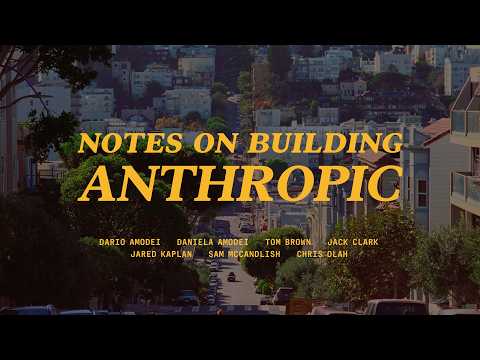
- The founding thesis treats safety and capability as coupled problems: doing safety well requires being at the frontier, not observing it from outside.
- Scaling behavior was a central planning input, making research bets and compute strategy depend on predicting how models improve with scale.
- A research-heavy company needs explicit mechanisms for turning safety concerns into engineering requirements rather than leaving them as commentary.
Latest indexed videos (2)
Trend radar (14d)
Open trend radar
Claude
10ch · 21v
AI Agents
8ch · 10v
Anthropic
7ch · 11v
Claude Code
6ch · 14v
Coding Agents
6ch · 12v
OpenAI
5ch · 15v
AI coding agents
5ch · 6v
TypeScript
4ch · 7v
OpenRouter
4ch · 4v
Evals
3ch · 9v
Jev
3ch · 6v
Codex
3ch · 6v
LangGraph
3ch · 5v
JavaScript
3ch · 4v
Fable 5.2
3ch · 4v
subagents
3ch · 3v

- The framing is breadth of use case, not benchmark deltas — treat this as positioning material, not a capability claim to plan around.
- Vignettes skew toward small, high-context problems (local infrastructure, historical archives, field robotics), suggesting value sits in domain data and iteration rather than model novelty.
- First-time builders appearing alongside researchers implies the toolchain cost — onboarding, prompting, deployment — has dropped enough for non-engineers to ship narrow utilities.