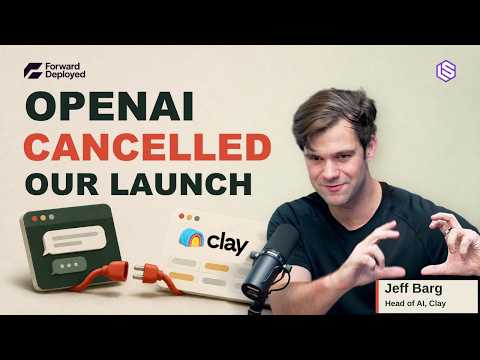
- Customers increasingly drive Clay workflows through outside coding agents, so Clay supports both its own agent and external harnesses instead of forcing a single interface.
- Lead-qualification evals have been saturated for roughly a year, pushing differentiation toward higher-level GTM workflow orchestration and customer fit logic.
- Scoring all 40M companies in Clay's dataset for fit costs about $1,500, making broad AI-driven account scoring economically practical.
Topic: LangGraph (5)
Trend radar (14d)
Open trend radar
Claude
10ch · 21v
AI Agents
8ch · 10v
Anthropic
7ch · 11v
Claude Code
6ch · 14v
Coding Agents
6ch · 12v
OpenAI
5ch · 15v
AI coding agents
5ch · 6v
TypeScript
4ch · 7v
OpenRouter
4ch · 4v
Evals
3ch · 9v
Jev
3ch · 6v
Codex
3ch · 6v
LangGraph
3ch · 5v
JavaScript
3ch · 4v
Fable 5.2
3ch · 4v
subagents
3ch · 3v

- Treat LLM calls as units of judgment, not as end-to-end decision engines.
- Keep arithmetic, thresholds, routing rules, and other deterministic logic in code; reserve Jev for ambiguous, fuzzy classification.
- Compose model judgments and facts through an explicit logic tree so each outcome can be traced and audited.
- Treat the agent harness as infrastructure you own: routing, tool calls, memory, and retries should live in your code, not in a vendor SDK.
- Provider neutrality is an economic hedge — model quality and per-token pricing shift quickly, and a coupled harness converts those shifts into rework.
- LangGraph and Deep Agents are positioned as open-source harness layers so behavior stays inspectable and portable across model backends.

- LangGraph is the orchestration substrate — stateful graphs of nodes and edges — while the LangChain framework sits above it as a tool-calling loop you extend via middleware rather than forking internals.
- Deep Agents packages the tedious parts of long-horizon agents (context summarization, a file system for scratch state) so you don't rebuild them per project.
- The split between evals (pre-launch) and traces (post-launch) is presented as the core reliability workflow; treat LangSmith as an observability/eval layer, not just a logger.

- Scope tool credentials per action and environment; an agent should never inherit broad production database privileges just to complete a task.
- Insert human approval before irreversible or high-blast-radius actions, not merely after the agent proposes them.
- Apply network egress rules and service allowlists so agents cannot reach unintended internal systems or exfiltrate data.