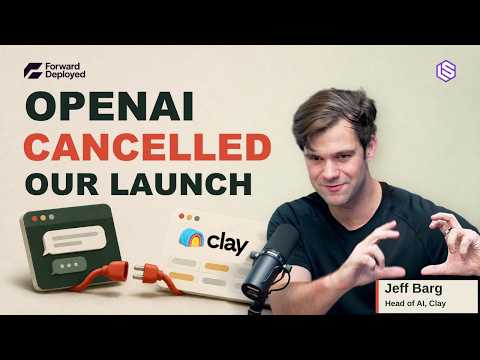
- Customers increasingly drive Clay workflows through outside coding agents, so Clay supports both its own agent and external harnesses instead of forcing a single interface.
- Lead-qualification evals have been saturated for roughly a year, pushing differentiation toward higher-level GTM workflow orchestration and customer fit logic.
- Scoring all 40M companies in Clay's dataset for fit costs about $1,500, making broad AI-driven account scoring economically practical.
Topic: frontier models (2)
Trend radar (14d)
Open trend radar
Claude
10ch · 21v
AI Agents
8ch · 10v
Anthropic
7ch · 11v
Claude Code
6ch · 14v
Coding Agents
6ch · 12v
OpenAI
5ch · 15v
AI coding agents
5ch · 6v
TypeScript
4ch · 7v
OpenRouter
4ch · 4v
Evals
3ch · 9v
Jev
3ch · 6v
Codex
3ch · 6v
LangGraph
3ch · 5v
JavaScript
3ch · 4v
Fable 5.2
3ch · 4v
subagents
3ch · 3v
- The founding thesis treats safety and capability as coupled problems: doing safety well requires being at the frontier, not observing it from outside.
- Scaling behavior was a central planning input, making research bets and compute strategy depend on predicting how models improve with scale.
- A research-heavy company needs explicit mechanisms for turning safety concerns into engineering requirements rather than leaving them as commentary.