
- Measure judges against hand-labeled production samples: ZoomInfo's LLM judge was only about 65% correct and over-accepted 118 of 500 steps.
- Give judges explicit tool receipts and require claims to match actual tool outcomes; agent-written summaries should not outweigh failed or missing tool calls.
- Replace one broad 'is this good?' prompt with narrow binary questions that can be answered from evidence, then use probability thresholds and fall back to an LLM for uncertain cases.
Topic: Evals (8)
Trend radar (14d)
Open trend radar
Claude
10ch · 21v
AI Agents
8ch · 10v
Anthropic
7ch · 11v
Claude Code
6ch · 14v
Coding Agents
6ch · 12v
OpenAI
5ch · 15v
AI coding agents
5ch · 6v
TypeScript
4ch · 7v
OpenRouter
4ch · 4v
Evals
3ch · 9v
Jev
3ch · 6v
Codex
3ch · 6v
LangGraph
3ch · 5v
JavaScript
3ch · 4v
Fable 5.2
3ch · 4v
subagents
3ch · 3v

- Price data on an exclusivity axis: the identical artifact can command a premium when a lab keeps it private or a discount when rivals can buy it too, so the deal term matters as much as the content.
- Calibrate difficulty to the frontier — tasks that are too hard stop being training signal and quietly become evals, while tasks that are too easy teach nothing.
- Budget for verifiers, not just prompts: an expert-designed grader that scores results reproducibly is what turns raw expert labor into a usable dataset.

- Customers increasingly drive Clay workflows through outside coding agents, so Clay supports both its own agent and external harnesses instead of forcing a single interface.
- Lead-qualification evals have been saturated for roughly a year, pushing differentiation toward higher-level GTM workflow orchestration and customer fit logic.
- Scoring all 40M companies in Clay's dataset for fit costs about $1,500, making broad AI-driven account scoring economically practical.

- Deep Agents lean on file system primitives (ls, read, grep) as the agent's interface to its environment, so search and navigation keep the working context small instead of dumping whole documents into the prompt.
- Context is treated as a scarce resource: grepping for a clue rather than reading the entire diary is the tutorial's stand-in for retrieving only the relevant slice of a large corpus.
- A power cut forcing a new thread illustrates durable state — scratch space and long-term memory persist across sessions, while a thread is just one bounded run.

- Freeze a small set of real agent traces and rerun each judge many times to separate judge noise from actual agent behavior.
- Track both accuracy/alignment and precision/consistency; binary pass/fail and continuous scores reveal different judge failure modes.
- In this five-trace, 100-run experiment, the LLM judges' mean variance was 92x to 913x Jev's on continuous scores.

- Treat LLM calls as units of judgment, not as end-to-end decision engines.
- Keep arithmetic, thresholds, routing rules, and other deterministic logic in code; reserve Jev for ambiguous, fuzzy classification.
- Compose model judgments and facts through an explicit logic tree so each outcome can be traced and audited.

- LangGraph is the orchestration substrate — stateful graphs of nodes and edges — while the LangChain framework sits above it as a tool-calling loop you extend via middleware rather than forking internals.
- Deep Agents packages the tedious parts of long-horizon agents (context summarization, a file system for scratch state) so you don't rebuild them per project.
- The split between evals (pre-launch) and traces (post-launch) is presented as the core reliability workflow; treat LangSmith as an observability/eval layer, not just a logger.
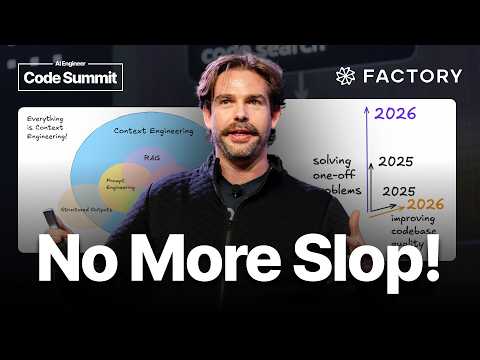
- Measure agents on sustained codebase evolution, not just isolated code generation; low Slop Code Bench scores show maintenance is the hard part.
- Apply forward pressure through clear plans and intent, and back pressure through tests, linting, reviews, and other guardrails that catch drift.
- Use visual alignment and agent-run tests to make expected behavior concrete before accepting generated changes.