
- Measure judges against hand-labeled production samples: ZoomInfo's LLM judge was only about 65% correct and over-accepted 118 of 500 steps.
- Give judges explicit tool receipts and require claims to match actual tool outcomes; agent-written summaries should not outweigh failed or missing tool calls.
- Replace one broad 'is this good?' prompt with narrow binary questions that can be answered from evidence, then use probability thresholds and fall back to an LLM for uncertain cases.
Latest indexed videos (12)
Trend radar (14d)
Open trend radar
Claude
10ch · 21v
AI Agents
8ch · 10v
Anthropic
7ch · 11v
Claude Code
6ch · 14v
Coding Agents
6ch · 12v
OpenAI
5ch · 15v
AI coding agents
5ch · 6v
TypeScript
4ch · 7v
OpenRouter
4ch · 4v
Evals
3ch · 9v
Jev
3ch · 6v
Codex
3ch · 6v
LangGraph
3ch · 5v
JavaScript
3ch · 4v
Fable 5.2
3ch · 4v
subagents
3ch · 3v

- Audit AI pipelines for steps that emit a label, rank, or yes/no verdict; these are decision tasks, not generation tasks, and are usually the cheapest to replace.
- A dedicated decision model delivered ~8x lower latency on expert routing while keeping follow-up suggestions on time in 99.2% of cases with zero invalid outputs.
- Self-tuning thresholds remove the hand-maintained cutoff tuning that typically rots as traffic and model behavior drift.

- Architectural bets on model size and latency can invert quickly; keep serving infrastructure flexible enough to host both trillion-parameter models and tiny task-specific ones.
- Small specialized decision models can replace large-model calls for narrow classification and extraction steps, cutting token spend by an order of magnitude.
- Routing routine subtasks through a cheap System 1 model and reserving the LLM for harder reasoning preserves answer quality while improving latency and cost.

- Treat AI-generated output as drafts you own: review, refine, and ship with explicit accountability instead of letting automation erase authorship.
- Define what good looks like with rubrics, references, and shared vocabulary so both humans and models can target quality.
- Build taste as a discriminator by studying adjacent crafts and evaluating many examples, not just generating more output.

- Do not industrialize unclear greenfield ideas; use factories to maintain and improve software customers already pay for.
- Brownfield loops should optimize around live customer feedback, existing promises, and continuous 24/7 operation.
- Model improvements make factory implementations simpler over time rather than more complex.

- A large agent swarm can coordinate using ordinary shared infrastructure: Git for versioned work and a database for state, with no domain-specific harness.
- The lead agent created its own coordination tables and the team reassigned work dynamically over a 30-hour run, suggesting orchestration can emerge from shared schemas.
- Memory quality scales with model capability: stronger models are better at deciding what to persist, and separating daily memory from long-term knowledge helps.

- Replace heavyweight release cycles with many small, monitored pushes so failures are isolated and easy to roll back.
- Use agents not just for code generation but for end-to-end operational loops, such as reproducing a bug, fixing it, and notifying affected users.
- Keep the human team tiny and let agents absorb coordination overhead that would otherwise require PMs, task trackers, and recurring meetings.
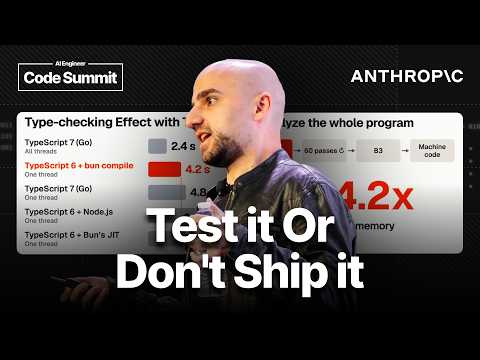
- Treat a legacy test suite as the contract: tests written before agents existed are the strongest signal that generated code preserves intended behavior.
- Keep multiple independent implementations (e.g. interpreter, JIT, and AOT paths) in agreement so differential testing catches divergence the agents introduce.
- Run agents in batches — generate broadly, then reconcile and fix — rather than expecting a single long pass to converge on correct code.

- Model factory output as a pipeline with a hard downstream limit: review bandwidth, integration capacity, and ownership decide how much generated code is actually usable.
- Treat context and memory as budgeted resources — per-agent window allocation, retrieval hygiene, and cost ceilings matter more to sustained throughput than raw model capability.
- Delegate in layers: lead agents scope work and hand off to specialized sub-agents with explicit roles, escalation paths, and review gates, mirroring how human teams scale.
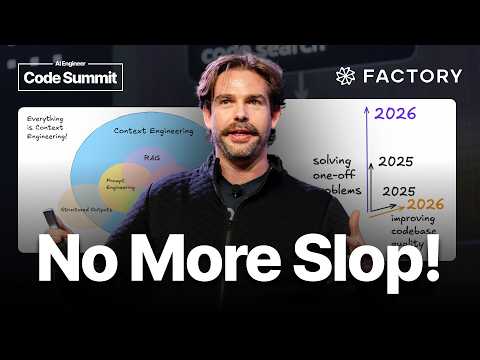
- Measure agents on sustained codebase evolution, not just isolated code generation; low Slop Code Bench scores show maintenance is the hard part.
- Apply forward pressure through clear plans and intent, and back pressure through tests, linting, reviews, and other guardrails that catch drift.
- Use visual alignment and agent-run tests to make expected behavior concrete before accepting generated changes.

- The harness stayed constant while results improved: benchmark tooling changes against model upgrades before assuming your agent architecture is the differentiator.
- His session data shows task duration stretching from ~2.5 to ~14 minutes with fewer human corrections, which moves the engineer's job from typing to direction and review.
- Attention is the scarce resource — 141 projects started but only 10–15 maintained — so enforce WIP limits and explicit kill criteria as real engineering practice.

- Choose local models from real task traces and agent benchmarks, not generic leaderboards alone.
- Quantization is a quality tradeoff; validate it against the workload before accepting memory or speed gains.
- Prefill/decode behavior and memory bandwidth should drive hardware selection, with batching tuned per chip and inference engine.