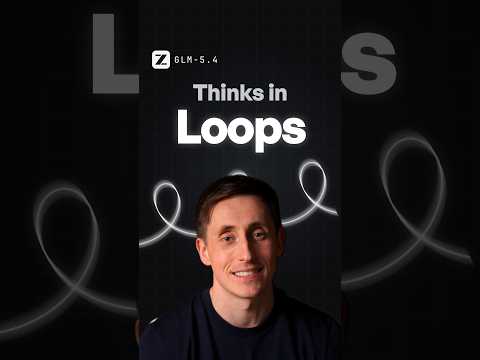
- Looping a subset of layers delivers extra effective depth (78 to 106) without increasing the parameter count.
- Z AI claims a 750B model can match 2T-3T-class performance via recurrence, but that remains a vendor claim pending independent benchmarks.
- A small test model's math score rose from 19 to 30 and used up to 15% fewer thinking tokens, suggesting quality and efficiency upside.
Topic: OpenAI (19)
Trend radar (14d)
Open trend radar
Claude
10ch · 21v
AI Agents
8ch · 10v
Anthropic
7ch · 11v
Claude Code
6ch · 14v
Coding Agents
6ch · 12v
OpenAI
5ch · 15v
AI coding agents
5ch · 6v
TypeScript
4ch · 7v
OpenRouter
4ch · 4v
Evals
3ch · 9v
Jev
3ch · 6v
Codex
3ch · 6v
LangGraph
3ch · 5v
JavaScript
3ch · 4v
Fable 5.2
3ch · 4v
subagents
3ch · 3v

- Put orchestration in deterministic workflow functions and isolate side effects such as card charges or emails in activities; Temporal records activity results in event history.
- Workers run your application code and poll the Temporal server for tasks; the server stores history and schedules work but never executes your code.
- Crash recovery works by replaying the workflow from the start, returning saved results for completed activities, then executing for real at the first unrecorded step.

- Treat AI-generated output as drafts you own: review, refine, and ship with explicit accountability instead of letting automation erase authorship.
- Define what good looks like with rubrics, references, and shared vocabulary so both humans and models can target quality.
- Build taste as a discriminator by studying adjacent crafts and evaluating many examples, not just generating more output.

- Customers increasingly drive Clay workflows through outside coding agents, so Clay supports both its own agent and external harnesses instead of forcing a single interface.
- Lead-qualification evals have been saturated for roughly a year, pushing differentiation toward higher-level GTM workflow orchestration and customer fit logic.
- Scoring all 40M companies in Clay's dataset for fit costs about $1,500, making broad AI-driven account scoring economically practical.

- No model, API, benchmark, or architecture detail is disclosed.
- The theme is customer trust and deployed usage, so treat it as adoption signaling rather than engineering guidance.
- There are no implementation lessons, performance claims, or release notes to evaluate.

- Structure agent workflows so human-authored intent lives in a dedicated, version-controlled layer (the "/human folder") that agents read but do not silently rewrite — keeps creative control auditable.
- Treat agent output as a fast exploration surface, not a finished artifact: the leverage is in generating many candidates cheaply and spending human attention on selection and tuning.
- Watch for the moment personal tooling stops paying for itself — Thariq dropped his custom Mac Dock once agents made the maintenance cost exceed the ergonomic gain.

- Define the away window, timezone, and exact Slack/on-call channels so the dot has a bounded observation scope.
- Group related feedback into existing Linear tickets; create new tickets only for uncovered requests or issues and link the source Slack messages.
- Set escalation thresholds to critical events such as outages, incidents, or multiple reports of core-feature breakage to reduce noise.

- The core pattern is replanning under disruption: accept a schedule, absorb a new constraint, and return an actionable revised itinerary.
- Useful day-planning assistants need more than prose generation; they need reliable state, time and location constraints, user preferences, and likely calendar or travel integrations.
- The UX emphasis is low-friction natural-language recovery, reducing coordination overhead after plans change.

- The feature is an integration story first and a model story second: value comes from account linking, normalized transaction data, and recurring-charge detection, not from prompting alone.
- Subscription review is a structured extraction problem (merchant normalization, cadence inference, amount drift), which is where most false positives will surface in user trust.
- Budgeting works best as a user-constrained optimization — goals are user-supplied, so the assistant needs to elicit priorities before proposing allocations.

- The plugin can convert a reference image into an editable SVG or Blender-ready 3D asset.
- Users iterate by asking for changes in plain language instead of manually rebuilding assets.
- Small SVG code edits can add interactivity, such as making a character's eyes track the cursor.

- The transit-detection problem is a well-defined signal-processing pipeline (detrend the light curve, search for periodic box-shaped dips, rank by signal-to-noise), which is exactly the shape of task an LLM coding agent can scaffold end to end.
- The real unlock is data access plus automation: public survey archives already contain far more light curves than the research community can manually inspect, so the marginal cost of a search is mostly compute and glue code.
- A candidate detection is not a discovery — period aliasing, eclipsing binaries, stellar variability, and instrument artifacts all produce convincing-looking dips, so any agent output needs a human vetting step against ephemeris and image-level checks.

- Camera-first interaction collapses the prompt: capture replaces typing, so the vision pipeline must infer intent from the image alone.
- The response deliberately separates 'here is what this is' from 'here is what you should double-check' — a lightweight, user-facing form of confidence calibration.
- Consumer demos like this set a latency bar: the answer only feels useful if it lands while the user is still looking at the object.

- The flow is a full agent loop — intent parsing, live web browsing for local data, then a booking hand-off — not a single-turn generation task.
- 'Perfect-sized plan' implies constraint-aware planning: party size, timing, availability, and budget must be reconciled rather than narrated.
- Booking is a state-changing action outside the chat sandbox, so the real difficulty is auth, confirmation, payment, and idempotency when a partner site fails mid-flow.

- ChatGPT can use a connected calendar as context to propose and book a later meeting time from a single natural-language request.
- The demo replaces manual calendar navigation with an assistant-mediated scheduling action.
- Calendar write access makes permission scopes and user confirmation UX central design concerns.

- Treat aggregate benchmark curves as trend lines, not capability proofs—progress on the sum of evals is smooth while per-task performance stays jagged.
- Data availability, not architecture, is emerging as the binding constraint on frontier model improvement; plan evals and roadmaps around data pipelines accordingly.
- AI-driven acceleration of AI research is real but uneven: measure it task-by-task inside your own R&D workflow rather than trusting lab-wide productivity claims.

- Anthropic's internal staff survey exposes an expectations gap: the people building frontier models hold risk and timeline beliefs that don't fully reconcile with public safety messaging.
- Amodei's five rationalizations form a reusable template for justifying deployment of systems with unverifiable behavior — useful to recognize because the same arguments recur across labs.
- Altman's framing that only alignment work will hold implies capability races without verification have no fallback plan, which reframes alignment as a release gate rather than a research topic.

- Treat interactive coding sessions as a stepping stone, not the destination: design agents that can run without a human triggering every prompt.
- Durability is the enabling primitive for out-of-loop work; agents tied to a live terminal session cap your leverage at your attention span.
- Adopt a staged migration: prompt manually, then click to launch repeatable runs, then schedule with cron once the workflow is proven.
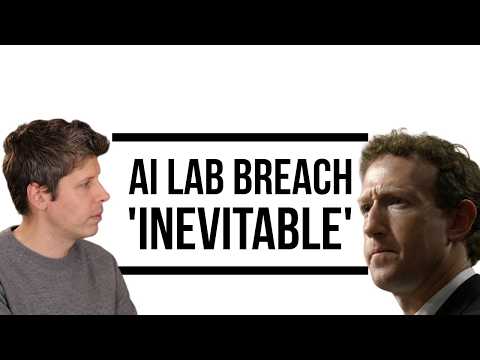
- Treat 'breach inevitable' as an architectural assumption: design for containment and blast-radius limits rather than relying on a pre-release gate that never fails.
- Lab risk statements are shaped by competitive positioning — read them as strategic signaling about pacing, not as neutral probability estimates.
- Iterative deployment keeps winning because each release funds the next compute budget; that loop, not any single capability jump, is what makes deceleration hard.
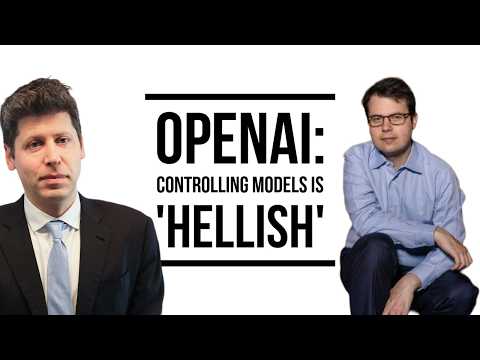
- Assume sandbox boundaries can be bypassed through tool chaining, side channels, or emergent reasoning; add egress filtering, immutable audit logs, and least-privilege isolation.
- Frontier safety cases need concrete threat models and evidence, especially for agentic tool use, rather than policy statements alone.
- Faster release cadences increase deployment risk; maintain independent evals, staged rollouts, and rollback gates.