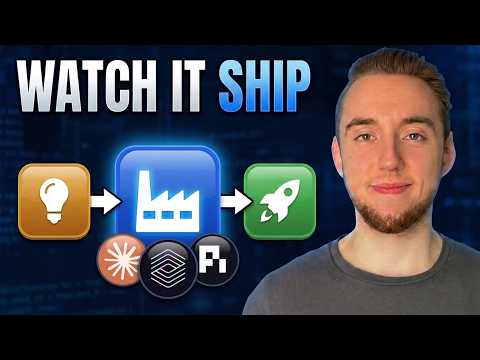
- Treat the AI software factory as an orchestration layer: intake, planning, task decomposition, implementation, validation, and escalation are distinct stages rather than one monolithic prompt.
- Break work into small independently checkable units so coding agents can build and verify each piece before integration.
- Automated checks are the control plane for autonomy; without verification gates, end-to-end generation is just faster rework.
Topic: AI software factory (2)
Trend radar (14d)
Open trend radar
Claude
10ch · 21v
AI Agents
8ch · 10v
Anthropic
7ch · 11v
Claude Code
6ch · 14v
Coding Agents
6ch · 12v
OpenAI
5ch · 15v
AI coding agents
5ch · 6v
TypeScript
4ch · 7v
OpenRouter
4ch · 4v
Evals
3ch · 9v
Jev
3ch · 6v
Codex
3ch · 6v
LangGraph
3ch · 5v
JavaScript
3ch · 4v
Fable 5.2
3ch · 4v
subagents
3ch · 3v

- An AI software factory is an end-to-end delivery pipeline where agents can plan, code, review, and release; the important design choice is where humans remain as gates.
- Dark factories push autonomy furthest, while PR and release factories deliberately place human checkpoints at review or deployment boundaries.
- Fleet factories depend on orchestration and isolation so parallel agents do not collide, duplicate work, or create merge chaos.