
- Put orchestration in deterministic workflow functions and isolate side effects such as card charges or emails in activities; Temporal records activity results in event history.
- Workers run your application code and poll the Temporal server for tasks; the server stores history and schedules work but never executes your code.
- Crash recovery works by replaying the workflow from the start, returning saved results for completed activities, then executing for real at the first unrecorded step.
Topic: Rust (5)
Trend radar (14d)
Open trend radar
Claude
10ch · 21v
AI Agents
8ch · 10v
Anthropic
7ch · 11v
Claude Code
6ch · 14v
Coding Agents
6ch · 12v
OpenAI
5ch · 15v
AI coding agents
5ch · 6v
TypeScript
4ch · 7v
OpenRouter
4ch · 4v
Evals
3ch · 9v
Jev
3ch · 6v
Codex
3ch · 6v
LangGraph
3ch · 5v
JavaScript
3ch · 4v
Fable 5.2
3ch · 4v
subagents
3ch · 3v

- The headline speedup matters less than equivalence: byte-for-byte output comparison gives a concrete correctness target for ports.
- Behavioral replay catches cross-language semantic differences, such as JavaScript counting emoji as two UTF-16 code units while the Rust port counted one.
- rust-anything gates AI-generated Rust against recorded behavior from the original implementation instead of trusting translation or normal unit tests alone.

- rust-anything targets language-to-Rust ports by pairing AI coding agents with behavioral tests, profiling, and benchmarks rather than relying on code generation alone.
- MCP is the integration layer for driving agents such as Claude Code, OpenAI Codex, and Cursor through a migration and verification workflow.
- The claimed Prettier rewrite highlights performance upside, but semantic parity across Unicode, floating-point behavior, and edge cases is the real acceptance test.
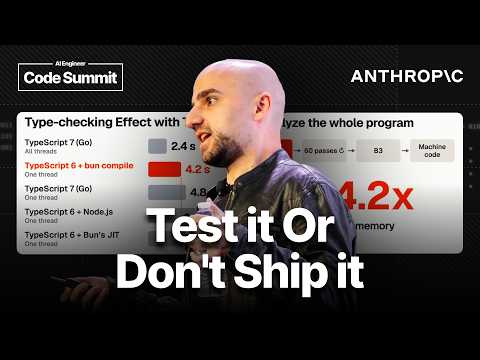
- Treat a legacy test suite as the contract: tests written before agents existed are the strongest signal that generated code preserves intended behavior.
- Keep multiple independent implementations (e.g. interpreter, JIT, and AOT paths) in agreement so differential testing catches divergence the agents introduce.
- Run agents in batches — generate broadly, then reconcile and fix — rather than expecting a single long pass to converge on correct code.

- Ollama provides both local model execution and an HTTP API, making it the main integration point for a desktop LLM app.
- Local model feasibility and speed depend heavily on available memory, quantization, and mixture-of-experts architecture.
- Tauri combines a Rust backend with a React frontend, enabling a native-style, distributable desktop wrapper around local AI.