
- Entry-level roles are shifting from writing boilerplate to reviewing, specifying, and validating machine-generated code — the bar for juniors rises rather than disappears.
- AI-generated pull requests and packages degrade open source signal-to-noise, making maintainer time and provenance checks the scarce resource.
- Treat `npm install` as a security decision: lockfiles, provenance attestation, dependency pinning, and minimal dependency trees matter more each year.
Topic: AI coding agents (6)
Trend radar (14d)
Open trend radar
Claude
10ch · 21v
AI Agents
8ch · 10v
Anthropic
7ch · 11v
Claude Code
6ch · 14v
Coding Agents
6ch · 12v
OpenAI
5ch · 15v
AI coding agents
5ch · 6v
TypeScript
4ch · 7v
OpenRouter
4ch · 4v
Evals
3ch · 9v
Jev
3ch · 6v
Codex
3ch · 6v
LangGraph
3ch · 5v
JavaScript
3ch · 4v
Fable 5.2
3ch · 4v
subagents
3ch · 3v

- Mirror attacker behavior: run a broad hunter pass for suspected vulnerabilities, then use separate verifier agents whose only job is to disprove each finding before you spend time proving it.
- Do not let a hunter agent grade its own work; isolate verification and parallelize hunters for coverage and speed when auditing a real codebase.
- Use five practical questions as the audit frame: broken authentication, cross-user data exposure, leaked secrets, prompt injection against AI features, and cost/availability abuse.

- Skip static recompilation when the target hardware matches: Leonida substitutes console system APIs rather than translating the game binary, the same compatibility-layer strategy Proton uses for Windows games on Linux.
- Shader translation is a tractable first milestone — all ~26,000 shaders were converted — but booting the main executable is where the real failure surface lives (13 crashes before a single frame on an RTX 4090).
- AI coding agents compressed contribution volume dramatically (10k+ commits in under three days), yet the project status still reads 'does not run' — throughput is not correctness.
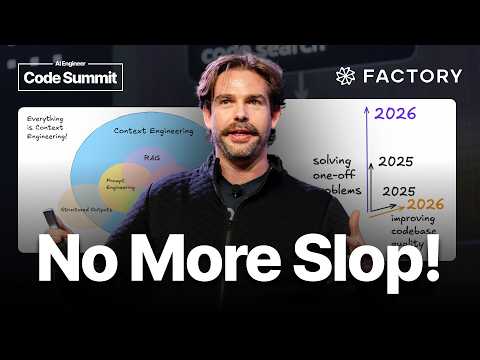
- Measure agents on sustained codebase evolution, not just isolated code generation; low Slop Code Bench scores show maintenance is the hard part.
- Apply forward pressure through clear plans and intent, and back pressure through tests, linting, reviews, and other guardrails that catch drift.
- Use visual alignment and agent-run tests to make expected behavior concrete before accepting generated changes.

- Treat agent config as executable surface: settings files, hooks, and MCP definitions can trigger downloads or shell commands the moment a session starts, so review them like code before cloning or opening a repo.
- Installing packages inside an agent session inherits the agent's environment — run installs in a sandbox or container without ambient cloud/API credentials mounted.
- Conversation transcripts and logs are de facto credential stores; avoid pasting env files or tokens into chat, and prune history rather than assuming it is private.

- Treat system understanding as production infrastructure: if no one can explain the system during an incident, AI-generated code becomes an operational liability.
- Scale automation only where humans can still audit, debug, and reconstruct decisions; avoid prompt-only workflows that hide causality.
- Measure agent adoption by incident-resolution capability and explainability, not by how many humans are removed from the loop.