
- Delegate by task boundary, not by tool call: a subagent should own a self-contained job whose intermediate steps the main agent never needs to see.
- Subagents are an isolation mechanism first and a parallelism mechanism second — each one gets a clean context window, which caps how much noise leaks back into the orchestrator.
- Parallel and async/background subagents suit independent, latency-tolerant work; specialist subagents suit narrow domains where a focused prompt and toolset outperform a generalist.
Topic: subagents (3)
Trend radar (14d)
Open trend radar
Claude
10ch · 21v
AI Agents
8ch · 10v
Anthropic
7ch · 11v
Claude Code
6ch · 14v
Coding Agents
6ch · 12v
OpenAI
5ch · 15v
AI coding agents
5ch · 6v
TypeScript
4ch · 7v
OpenRouter
4ch · 4v
Evals
3ch · 9v
Jev
3ch · 6v
Codex
3ch · 6v
LangGraph
3ch · 5v
JavaScript
3ch · 4v
Fable 5.2
3ch · 4v
subagents
3ch · 3v
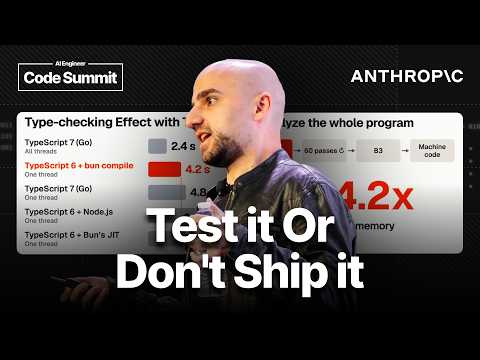
- Treat a legacy test suite as the contract: tests written before agents existed are the strongest signal that generated code preserves intended behavior.
- Keep multiple independent implementations (e.g. interpreter, JIT, and AOT paths) in agreement so differential testing catches divergence the agents introduce.
- Run agents in batches — generate broadly, then reconcile and fix — rather than expecting a single long pass to converge on correct code.

- Delegate to agents when the task has a clear oracle such as tests, repro steps, or a reference suite; keep architecture, API design, and ambiguous trade-offs human-owned.
- Prime agents with domain vocabulary and ordering constraints; without that context they often land on a technically valid but suboptimal first solution.
- Reduce nuance in interfaces and codebases where possible: ambiguous requirements invite slop and wrong-path convergence.