
- Put orchestration in deterministic workflow functions and isolate side effects such as card charges or emails in activities; Temporal records activity results in event history.
- Workers run your application code and poll the Temporal server for tasks; the server stores history and schedules work but never executes your code.
- Crash recovery works by replaying the workflow from the start, returning saved results for completed activities, then executing for real at the first unrecorded step.
Topic: TypeScript (7)
Trend radar (14d)
Open trend radar
Claude
10ch · 21v
AI Agents
8ch · 10v
Anthropic
7ch · 11v
Claude Code
6ch · 14v
Coding Agents
6ch · 12v
OpenAI
5ch · 15v
AI coding agents
5ch · 6v
TypeScript
4ch · 7v
OpenRouter
4ch · 4v
Evals
3ch · 9v
Jev
3ch · 6v
Codex
3ch · 6v
LangGraph
3ch · 5v
JavaScript
3ch · 4v
Fable 5.2
3ch · 4v
subagents
3ch · 3v

- The headline speedup matters less than equivalence: byte-for-byte output comparison gives a concrete correctness target for ports.
- Behavioral replay catches cross-language semantic differences, such as JavaScript counting emoji as two UTF-16 code units while the Rust port counted one.
- rust-anything gates AI-generated Rust against recorded behavior from the original implementation instead of trusting translation or normal unit tests alone.

- rust-anything targets language-to-Rust ports by pairing AI coding agents with behavioral tests, profiling, and benchmarks rather than relying on code generation alone.
- MCP is the integration layer for driving agents such as Claude Code, OpenAI Codex, and Cursor through a migration and verification workflow.
- The claimed Prettier rewrite highlights performance upside, but semantic parity across Unicode, floating-point behavior, and edge cases is the real acceptance test.
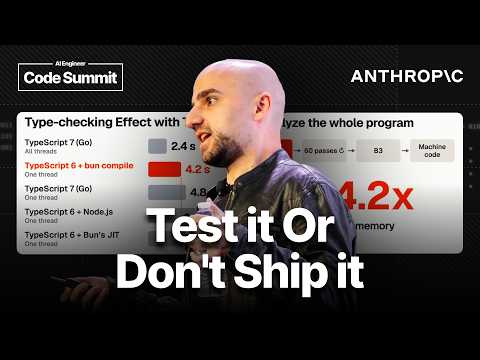
- Treat a legacy test suite as the contract: tests written before agents existed are the strongest signal that generated code preserves intended behavior.
- Keep multiple independent implementations (e.g. interpreter, JIT, and AOT paths) in agreement so differential testing catches divergence the agents introduce.
- Run agents in batches — generate broadly, then reconcile and fix — rather than expecting a single long pass to converge on correct code.

- Treat AI agents as the default implementation path and reserve manual coding for architecture, tricky debugging, correctness review, and unusual edge cases.
- The durable skills are system design, debugging, code review, product judgment, and fast adaptation, not raw syntax recall.
- React and TypeScript developers have an edge because years of framework churn trained them to learn moving targets instead of defending a fixed stack.
- Use grilling and a project glossary before coding so the agent shares the same domain model and can make better implementation choices.
- Prototype multiple UI/UX variants when trade-offs are about feel; negative examples often reveal requirements as clearly as successful ones.
- Split large AI-generated changes into stacked diffs so human review stays focused and mergeable.

- Delegate to agents when the task has a clear oracle such as tests, repro steps, or a reference suite; keep architecture, API design, and ambiguous trade-offs human-owned.
- Prime agents with domain vocabulary and ordering constraints; without that context they often land on a technically valid but suboptimal first solution.
- Reduce nuance in interfaces and codebases where possible: ambiguous requirements invite slop and wrong-path convergence.