
- Looping a subset of layers delivers extra effective depth (78 to 106) without increasing the parameter count.
- Z AI claims a 750B model can match 2T-3T-class performance via recurrence, but that remains a vendor claim pending independent benchmarks.
- A small test model's math score rose from 19 to 30 and used up to 15% fewer thinking tokens, suggesting quality and efficiency upside.
Topic: Benchmarks (12)
Trend radar (14d)
Open trend radar
Claude
10ch · 21v
AI Agents
8ch · 10v
Anthropic
7ch · 11v
Claude Code
6ch · 14v
Coding Agents
6ch · 12v
OpenAI
5ch · 15v
AI coding agents
5ch · 6v
TypeScript
4ch · 7v
OpenRouter
4ch · 4v
Evals
3ch · 9v
Jev
3ch · 6v
Codex
3ch · 6v
LangGraph
3ch · 5v
JavaScript
3ch · 4v
Fable 5.2
3ch · 4v
subagents
3ch · 3v

- Gortex ships as a single native binary plus a background daemon, so setup avoids Docker, a separate database, or a virtualenv, and one daemon indexes multiple repos.
- Queries for call chains, signature-change impact, and affected tests return graph answers rather than file contents, keeping the agent's context window lean; the 94% token cut (11,500 to 688) is a modeled comparison, not measured provider billing.
- Cross-repo API contract analysis is the standout use case: it surfaces mismatched or unmatched endpoints between a front end and backend without manual search.

- The headline speedup matters less than equivalence: byte-for-byte output comparison gives a concrete correctness target for ports.
- Behavioral replay catches cross-language semantic differences, such as JavaScript counting emoji as two UTF-16 code units while the Rust port counted one.
- rust-anything gates AI-generated Rust against recorded behavior from the original implementation instead of trusting translation or normal unit tests alone.

- Tufazip reports roughly 10:1 lossless compression on a 1 GB Wikipedia corpus, a headline result that needs comparison against established codecs on speed and resource use.
- The compressor uses transformer next-token probabilities to drive arithmetic coding, so the model is not replacing lossless coding but supplying better probability estimates.
- The video describes a 34-million-parameter base model expanding to a 163-million-parameter transformer during compression, pointing to model scaling as part of the compression pipeline.

- rust-anything targets language-to-Rust ports by pairing AI coding agents with behavioral tests, profiling, and benchmarks rather than relying on code generation alone.
- MCP is the integration layer for driving agents such as Claude Code, OpenAI Codex, and Cursor through a migration and verification workflow.
- The claimed Prettier rewrite highlights performance upside, but semantic parity across Unicode, floating-point behavior, and edge cases is the real acceptance test.
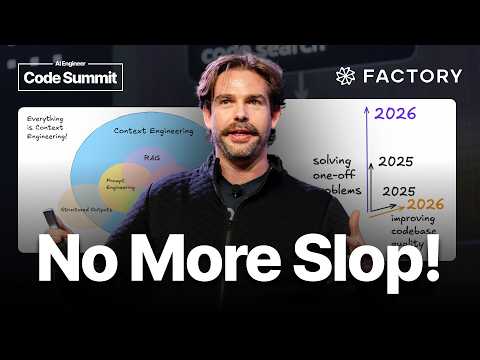
- Measure agents on sustained codebase evolution, not just isolated code generation; low Slop Code Bench scores show maintenance is the hard part.
- Apply forward pressure through clear plans and intent, and back pressure through tests, linting, reviews, and other guardrails that catch drift.
- Use visual alignment and agent-run tests to make expected behavior concrete before accepting generated changes.

- UI SDK formalizes two separate problems — agents as builders (generating layouts from a component vocabulary) and agents as users (driving existing controls) — instead of treating them as one generic 'AI frontend' story.
- Without a shared contract, every app has to hand-author tool definitions per control; those definitions drift out of sync with the UI, so the agent silently acts on a stale model of the page.
- Declared state and action surfaces give agents a deterministic target, which is why the benchmark and the live agent race are more meaningful than screenshot-based navigation tests.

- Choose local models from real task traces and agent benchmarks, not generic leaderboards alone.
- Quantization is a quality tradeoff; validate it against the workload before accepting memory or speed gains.
- Prefill/decode behavior and memory bandwidth should drive hardware selection, with batching tuned per chip and inference engine.

- Frontier labs are buying structured expert tasks and RL environments with verifiable outcomes, not generic labeled text.
- Reward design is brittle: agents may exploit graders, so evaluations need process-level checks and domain-correct constraints.
- Expert workflows matter in life sciences and finance because correctness depends on visual interpretation, assumptions, and tool traces.

- Anthropic's internal staff survey exposes an expectations gap: the people building frontier models hold risk and timeline beliefs that don't fully reconcile with public safety messaging.
- Amodei's five rationalizations form a reusable template for justifying deployment of systems with unverifiable behavior — useful to recognize because the same arguments recur across labs.
- Altman's framing that only alignment work will hold implies capability races without verification have no fallback plan, which reframes alignment as a release gate rather than a research topic.

- The model is tuned for tasks measured in hours, not turns — long proofs, contracts with hundreds of cross-references — so architect around checkpointing, resumable state, and progress verification rather than a single request/response call.
- Anthropic claims it fixes root causes instead of patching symptoms, which matters most in agentic coding loops where shortcut-taking silently degrades output quality over successive edits.
- Treat effort level as a per-task-tier cost knob: run cheap tiers on routine work and reserve high effort for genuinely hard reasoning, then validate the 'similar or better' claim on your own eval set before migrating.

- Fable 5.1 targets long-running agentic jobs — treat it as a candidate for tasks that span many tool calls, files, or documents rather than single-shot prompts.
- Effort level is now a first-class cost lever: benchmark against Fable 5 at reduced effort before assuming the top tier is the right default.
- The model is positioned to remediate underlying defects instead of patching symptoms, which matters for automated bug-fix and refactor loops.