
- Gortex ships as a single native binary plus a background daemon, so setup avoids Docker, a separate database, or a virtualenv, and one daemon indexes multiple repos.
- Queries for call chains, signature-change impact, and affected tests return graph answers rather than file contents, keeping the agent's context window lean; the 94% token cut (11,500 to 688) is a modeled comparison, not measured provider billing.
- Cross-repo API contract analysis is the standout use case: it surfaces mismatched or unmatched endpoints between a front end and backend without manual search.
Topic: Claude Code (10)
Trend radar (14d)
Open trend radar
Claude
10ch · 21v
AI Agents
8ch · 10v
Anthropic
7ch · 11v
Claude Code
6ch · 14v
Coding Agents
6ch · 12v
OpenAI
5ch · 15v
AI coding agents
5ch · 6v
TypeScript
4ch · 7v
OpenRouter
4ch · 4v
Evals
3ch · 9v
Jev
3ch · 6v
Codex
3ch · 6v
LangGraph
3ch · 5v
JavaScript
3ch · 4v
Fable 5.2
3ch · 4v
subagents
3ch · 3v

- The headline speedup matters less than equivalence: byte-for-byte output comparison gives a concrete correctness target for ports.
- Behavioral replay catches cross-language semantic differences, such as JavaScript counting emoji as two UTF-16 code units while the Rust port counted one.
- rust-anything gates AI-generated Rust against recorded behavior from the original implementation instead of trusting translation or normal unit tests alone.
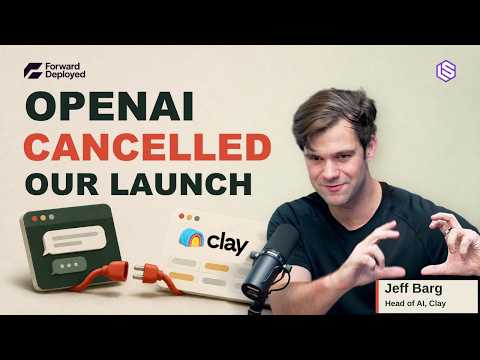
- Customers increasingly drive Clay workflows through outside coding agents, so Clay supports both its own agent and external harnesses instead of forcing a single interface.
- Lead-qualification evals have been saturated for roughly a year, pushing differentiation toward higher-level GTM workflow orchestration and customer fit logic.
- Scoring all 40M companies in Clay's dataset for fit costs about $1,500, making broad AI-driven account scoring economically practical.

- rust-anything targets language-to-Rust ports by pairing AI coding agents with behavioral tests, profiling, and benchmarks rather than relying on code generation alone.
- MCP is the integration layer for driving agents such as Claude Code, OpenAI Codex, and Cursor through a migration and verification workflow.
- The claimed Prettier rewrite highlights performance upside, but semantic parity across Unicode, floating-point behavior, and edge cases is the real acceptance test.

- Mirror attacker behavior: run a broad hunter pass for suspected vulnerabilities, then use separate verifier agents whose only job is to disprove each finding before you spend time proving it.
- Do not let a hunter agent grade its own work; isolate verification and parallelize hunters for coverage and speed when auditing a real codebase.
- Use five practical questions as the audit frame: broken authentication, cross-user data exposure, leaked secrets, prompt injection against AI features, and cost/availability abuse.

- Structure agent workflows so human-authored intent lives in a dedicated, version-controlled layer (the "/human folder") that agents read but do not silently rewrite — keeps creative control auditable.
- Treat agent output as a fast exploration surface, not a finished artifact: the leverage is in generating many candidates cheaply and spending human attention on selection and tuning.
- Watch for the moment personal tooling stops paying for itself — Thariq dropped his custom Mac Dock once agents made the maintenance cost exceed the ergonomic gain.
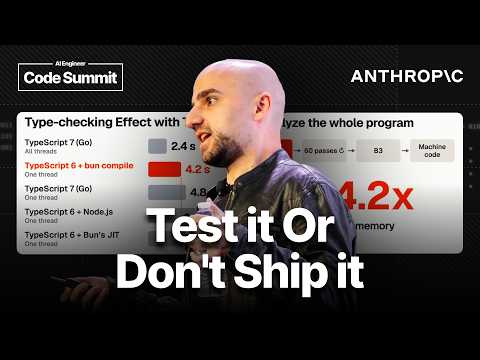
- Treat a legacy test suite as the contract: tests written before agents existed are the strongest signal that generated code preserves intended behavior.
- Keep multiple independent implementations (e.g. interpreter, JIT, and AOT paths) in agreement so differential testing catches divergence the agents introduce.
- Run agents in batches — generate broadly, then reconcile and fix — rather than expecting a single long pass to converge on correct code.

- Agents can be hosted on a remote machine and reached over SSH, which decouples long-running agent work from the local laptop's power and sleep state.
- Multiple agent CLIs (Claude Code and Codex) run side by side in one manager, so comparison and parallel tasking happen without juggling terminals.
- The interface is itself prompt-driven, meaning layout and visual theme are configuration rather than hardcoded product decisions.

- Treat agent config as executable surface: settings files, hooks, and MCP definitions can trigger downloads or shell commands the moment a session starts, so review them like code before cloning or opening a repo.
- Installing packages inside an agent session inherits the agent's environment — run installs in a sandbox or container without ambient cloud/API credentials mounted.
- Conversation transcripts and logs are de facto credential stores; avoid pasting env files or tokens into chat, and prune history rather than assuming it is private.

- Real usage telemetry beats leaderboard placement: open-weight traffic in T3 Code sits near 0.5% of turns and 0.7% of tokens, and the share of installs that ever touched one dropped from 16% to 6%.
- Public benchmark scores are brittle — re-running DeepSWE tasks with small prompt/code perturbations cost open-weight models 10 to 30 points while the strongest closed models held flat, which is the signature of eval overfitting.
- Long-horizon coherence across sub-agents is the capability that actually separates model tiers, and aggregate indices hide it; evaluate on task length and ambiguity that match your workload, not on a single composite score.