Heuristic Mode

Topic: Coding Agents (16)

Last sync: Nov 28, 2026 · 17:04 UTC (running)
Reset

Trend radar (14d)

Open trend radar
Better Stack Nov 28, 2026 AI summary

94% Fewer Tokens? I Tested Gortex With Claude Code

Gortex is an open-source code knowledge graph that pre-indexes functions, callers, dependencies, and cross-repo API contracts so that agents like Claude Code can query structure directly instead of grepping and reading whole files. The reviewer installs it on macOS, verifies the token reduction and multi-repo workflows, and finds genuine utility for change-impact and test discovery, while flagging that the 94% savings figure is only an estimate. The practical caveat is that agents can silently ignore the graph tools and fall back to file reading, so tool usage needs verification.

  • Gortex ships as a single native binary plus a background daemon, so setup avoids Docker, a separate database, or a virtualenv, and one daemon indexes multiple repos.
  • Queries for call chains, signature-change impact, and affected tests return graph answers rather than file contents, keeping the agent's context window lean; the 94% token cut (11,500 to 688) is a modeled comparison, not measured provider billing.
  • Cross-repo API contract analysis is the standout use case: it surfaces mismatched or unmatched endpoints between a front end and backend without manual search.
Latent Space Nov 26, 2026 AI summary

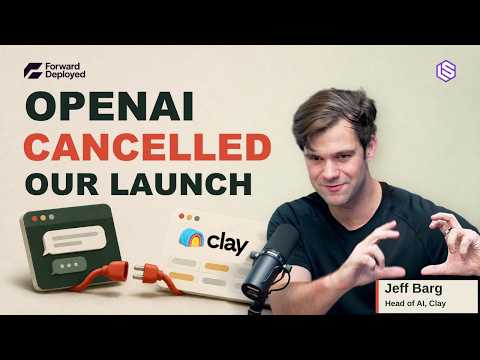
How Clay Builds GTM Agents — Jeff Barg, Head of AI

Clay's Head of AI describes how GTM agent work is shifting toward external coding harnesses like Claude Code while Clay still maintains its own agent experience. The practical lesson is that agent products increasingly compete on workflow integration, evaluation depth, cost math, and infrastructure reliability rather than raw model choice alone. Engineers should care because the talk maps where frontier model gains have saturated and where post-training, queueing, and observability still matter.

  • Customers increasingly drive Clay workflows through outside coding agents, so Clay supports both its own agent and external harnesses instead of forcing a single interface.
  • Lead-qualification evals have been saturated for roughly a year, pushing differentiation toward higher-level GTM workflow orchestration and customer fit logic.
  • Scoring all 40M companies in Clay's dataset for fit costs about $1,500, making broad AI-driven account scoring economically practical.
Cole Medin Nov 26, 2026 AI summary

The Best Defense Against This Wave of AI Attacks: Hack Yourself First (Try This Now)

Cole Medin argues that AI-accelerated attackers make proactive, agent-driven security auditing a baseline engineering practice. He outlines a hunter/verifier workflow that scans broadly for possible vulnerabilities, then uses independent agents to aggressively disprove each finding before proof and patching. The demo applies Cloudflare's open-source security-audit skill to his Archon repository and turns one low-severity issue into a test-backed fix.

  • Mirror attacker behavior: run a broad hunter pass for suspected vulnerabilities, then use separate verifier agents whose only job is to disprove each finding before you spend time proving it.
  • Do not let a hunter agent grade its own work; isolate verification and parallelize hunters for coverage and speed when auditing a real codebase.
  • Use five practical questions as the audit frame: broken authentication, cross-user data exposure, leaked secrets, prompt injection against AI features, and cost/availability abuse.
Latent Space Nov 25, 2026 AI summary

The Revolution vs The Renaissance — Thariq Shihipar, OpenAI

Thariq Shihipar revisits his earlier predictions about coding agents and lands on a craft-first framing: agents collapse the cost of trying things, but the durable value sits with humans who keep taste and judgment in the loop. He demos a "/human folder" pattern for hand-tuning game feel in his fighting game, explains why he abandoned a custom Mac Dock he built, and digs into decision models for who gets to pick which experiments consume compute.

  • Structure agent workflows so human-authored intent lives in a dedicated, version-controlled layer (the "/human folder") that agents read but do not silently rewrite — keeps creative control auditable.
  • Treat agent output as a fast exploration surface, not a finished artifact: the leverage is in generating many candidates cheaply and spending human attention on selection and tuning.
  • Watch for the moment personal tooling stops paying for itself — Thariq dropped his custom Mac Dock once agents made the maintenance cost exceed the ergonomic gain.
AI Engineer Nov 25, 2026 AI summary

How 21 People Built a $100M+ Agent Company — Quinn Slack, Amp

Amp, a 21-person spinoff from Sourcegraph, reorganized its entire operating model around coding agents after being unable to hire for a year. Quinn Slack argues that small teams can ship faster by eliminating traditional management layers, running work through agents, and replacing big releases with small, monitored pushes. The company reports over $100M in ARR while operating at a fraction of the headcount of comparable software businesses.

  • Replace heavyweight release cycles with many small, monitored pushes so failures are isolated and easy to roll back.
  • Use agents not just for code generation but for end-to-end operational loops, such as reproducing a bug, fixing it, and notifying affected users.
  • Keep the human team tiny and let agents absorb coordination overhead that would otherwise require PMs, task trackers, and recurring meetings.
Better Stack Nov 24, 2026 AI summary

GTA6 Ported To PC After Just 3 Days (Open-Source)

A fan-driven GitHub project called Leonida is attempting to bring GTA 6 to PC without waiting for Rockstar, and the video walks through the technical shortcut that makes it plausible: because the Xbox Series uses AMD hardware close to a gaming PC, the project reimplements the console's system software instead of recompiling the game itself. The headline is velocity — tens of thousands of commits in days, largely attributed to AI coding agents — but the port still crashes before rendering a frame, and Take-Two's litigation history hangs over the effort.

  • Skip static recompilation when the target hardware matches: Leonida substitutes console system APIs rather than translating the game binary, the same compatibility-layer strategy Proton uses for Windows games on Linux.
  • Shader translation is a tractable first milestone — all ~26,000 shaders were converted — but booting the main executable is where the real failure surface lives (13 crashes before a single frame on an RTX 4090).
  • AI coding agents compressed contribution volume dramatically (10k+ commits in under three days), yet the project status still reads 'does not run' — throughput is not correctness.
Cole Medin Nov 23, 2026 AI summary

Hackers Are Coming for Your AI Coding Agent (Lock It Down Now)

Coding agents have become a viable attack path: malicious settings files, trojaned packages, and leaked credentials in transcripts give adversaries a foothold with the same permissions your agent has. Cole walks through several recent real-world incidents, then layers practical hardening steps — scoped keys, tighter allowlists, and spend monitoring — on top of a free audit skill that scans an agent's configuration and installs a secrets guard hook.

  • Treat agent config as executable surface: settings files, hooks, and MCP definitions can trigger downloads or shell commands the moment a session starts, so review them like code before cloning or opening a repo.
  • Installing packages inside an agent session inherits the agent's environment — run installs in a sandbox or container without ambient cloud/API credentials mounted.
  • Conversation transcripts and logs are de facto credential stores; avoid pasting env files or tokens into chat, and prune history rather than assuming it is private.
AI Engineer Nov 22, 2026 AI summary

Build the Workshop Before the Software Factory — Armin Ronacher, Earendil

Armin Ronacher argues that his Pi coding agent's harness is essentially unchanged from a year ago, yet it performs far better — proof that capability gains came from the models, not the scaffolding. Because human attention, not agent throughput, is now the binding constraint, he recommends perfecting a workshop that reliably produces excellent software before scaling a factory that produces more of it. The talk backs this with personal session telemetry and concrete practices for review, pushback, and durable long-running agents.

  • The harness stayed constant while results improved: benchmark tooling changes against model upgrades before assuming your agent architecture is the differentiator.
  • His session data shows task duration stretching from ~2.5 to ~14 minutes with fewer human corrections, which moves the engineer's job from typing to direction and review.
  • Attention is the scarce resource — 141 projects started but only 10–15 maintained — so enforce WIP limits and explicit kill criteria as real engineering practice.
Fireship Nov 20, 2026 AI summary

If you’ve deployed anything since 2015, I have bad news...

A three-day incident roundup covering three unrelated but similarly shaped failures: a flaw in Optimizely's client-side experimentation script that let attackers run code on 178 high-traffic sites, a Java path where a single Base64-encoded payload escalates to remote code execution, and a decade-old Nginx defect that left a huge share of the web exposed. The through-line is that the inherited layer — vendor tags, framework defaults, the reverse proxy nobody owns — carries the largest blast radius and the slowest patch cadence.

  • Third-party scripts (analytics, A/B testing, chat widgets) execute with full page privileges, so a vendor-side bug is effectively your bug — enforce CSP and Subresource Integrity, and keep an explicit inventory of every external origin you load.
  • Any flow that decodes Base64 from an untrusted request and hands the bytes to a deserializer or reflective loader is an RCE sink; prefer data-only parsing and treat decode-then-instantiate as a code smell in review.
  • A ten-year-old defect in Nginx means the edge proxy is the highest-leverage single point of failure on the internet — version-pin it, track advisories, and keep a tested path to swap or patch the proxy layer independently of app deploys.
Fireship Nov 19, 2026 AI summary

The only software that didn’t break this week...

Solid 2.0 lands as the framework's first major version in roughly five years, arriving in a week where plenty of other software was busy falling over. The release keeps Solid's fine-grained, no-virtual-DOM reactivity model but pushes async data handling into the core so loading and error states stop being hand-rolled boilerplate. Engineers tracking the signals ecosystem should care because it's the clearest look yet at what a post-React-hooks component model looks like when reactivity is the primitive rather than a bolted-on scheduler.

  • Solid 2.0 is a genuine major bump after years of 1.x point releases — expect breaking changes, so pin versions and read the migration guide before touching production code.
  • The core bet is unchanged: signals plus direct DOM updates, no virtual DOM diffing, so re-render cost stays proportional to what actually changed.
  • Async is now a first-class concern in the reactive graph rather than something you wire up with effects and manual loading flags, which shrinks the surface area for race conditions.
Cole Medin Nov 19, 2026 AI summary

This Skill Turns Claude Code Into an Expert Video Editor (I'm Giving It Away)

Cole Medin demonstrates a free, open-source Claude Code skill that converts a folder of raw footage into a finished video, combining agent judgment with deterministic helper scripts. The interesting engineering pattern is packaging a repeatable media pipeline as a portable agent skill with persistent lessons and brand configuration, so the agent improves on channel-specific corrections over time.

  • Structure the editing workflow as a skill: declarative instructions plus helper scripts that the coding agent invokes against a footage directory.
  • Split responsibilities between deterministic media operations (cuts, transitions, audio processing) and agent reasoning for judgment calls like mid-word stumbles or clipped sentences.
  • Use a persistent lessons file and brand color config so corrections accumulate and the skill adapts to a specific channel's style instead of resetting each run.
Matt Pocock Nov 17, 2026 AI summary

LIVE: Writing code that doesn't suck with the creators of Pi

Matt Pocock talks with Pi creators Mario Zechner and Armin Ronacher about where agentic coding actually helps and where it still fails. The discussion frames agents as strong at tactical, verifiable loops but weak on ambiguous architecture, API design, and strategic trade-offs, so engineers need tighter scope, domain context, and quality gates. The throughline is that cheap code raises the value of judgment and process rather than eliminating them.

  • Delegate to agents when the task has a clear oracle such as tests, repro steps, or a reference suite; keep architecture, API design, and ambiguous trade-offs human-owned.
  • Prime agents with domain vocabulary and ordering constraints; without that context they often land on a technically valid but suboptimal first solution.
  • Reduce nuance in interfaces and codebases where possible: ambiguous requirements invite slop and wrong-path convergence.
Dave Ebbelaar Nov 11, 2026 AI summary

Learn Local AI in 30 Minutes - Run LLMs locally for FREE

This tutorial shows how to build a local desktop chat app that runs open LLMs through Ollama, using Tauri with a Rust backend and React frontend. It covers the hardware and model-format tradeoffs that determine what runs well locally, then extends the app into a coding agent and a bundled macOS application.

  • Ollama provides both local model execution and an HTTP API, making it the main integration point for a desktop LLM app.
  • Local model feasibility and speed depend heavily on available memory, quantization, and mixture-of-experts architecture.
  • Tauri combines a Rust backend with a React frontend, enabling a native-style, distributable desktop wrapper around local AI.

Latent Space Nov 10, 2026 AI summary

Designing for Agents — Zeno Rocha, Resend

Zeno Rocha walks through what happens when a coding agent, not a human, chooses and onboards an email provider — from which vendor Claude Code names across model versions to whether the agent can find pricing, register an account, and send a first message unattended. The talk reframes developer marketing as machine-readable surface area and then follows the mail itself through Gmail throttling, unreliable open tracking, and shared reputation risk. It is a practical look at designing products for an agent as the primary user.

  • Treat agent recommendations as a measurable ranking: periodically probe what current model versions say when asked to pick a provider, and optimize docs, structured pricing, and citable pages rather than assuming brand awareness transfers.
  • Design the full agent experience (AX) as a funnel — discover pricing in Markdown, register without a human, and send a first email in one session; each unattended step that fails is a lost customer no dashboard will show.
  • Weigh MCP tool granularity deliberately: 80+ named tools aid discovery but increase wrong-tool selection and context cost, so instrument tool-choice accuracy and consider fewer parameterized tools.
IndyDevDan Nov 09, 2026 AI summary

ZERO to RUNNING Software Factory In 16 Minutes (LIQUID Software)

IndyDevDan demonstrates mounting a reusable 'Tiny Software Factory' scaffold into an existing product codebase and specializing it, via a single skill and command, into an unattended AI analytics agent. The argument is that the human prompt loop, not model capability, is the current constraint, and that engineers should shift to supervising agents that run continuously and only surface real decisions. The broader thesis is 'liquid software': generic agentic tooling that takes the shape of whatever problem you point it at.

  • Treat agent harnesses as parameterized scaffolds: ship sensible defaults, then specialize per problem instead of rebuilding orchestration each time.
  • The three-step mount pattern (initialize, configure, specialize) makes an agent factory portable across codebases and repeatable across projects.
  • Hand the in-loop agent a concrete written plan (~150 lines) rather than interactive prompting; the plan becomes the durable artifact the agent executes against.
IndyDevDan Nov 02, 2026 AI summary

Tiny Software Factories: Agentic Engineering DONE WRONG

The video argues that the human sitting in the terminal is the real throughput limit, and that most current agent work can run with the engineer positioned near the loop rather than inside it. It introduces the "tiny software factory": one narrow problem, one proactive agent, cron-driven, on a single durable box, while deliberately embracing shortcuts that won't scale. The point is a local maximum for shipping speed today, with the anti-patterns named openly so you know what you're borrowing against later.

  • Treat yourself as the bottleneck: if you're hand-prompting a single agent back and forth, you are the orchestration layer, and the system can't run without you.
  • Scope a factory to exactly one problem with one proactive agent on a schedule; breadth is what kills small autonomous setups.
  • Durability matters more than elegance: a long-lived server running cron beats an ephemeral chat session for around-the-clock work.