
- Measure judges against hand-labeled production samples: ZoomInfo's LLM judge was only about 65% correct and over-accepted 118 of 500 steps.
- Give judges explicit tool receipts and require claims to match actual tool outcomes; agent-written summaries should not outweigh failed or missing tool calls.
- Replace one broad 'is this good?' prompt with narrow binary questions that can be answered from evidence, then use probability thresholds and fall back to an LLM for uncertain cases.
Topic: Claude (25)
Trend radar (14d)
Open trend radar
Claude
10ch · 21v
AI Agents
8ch · 10v
Anthropic
7ch · 11v
Claude Code
6ch · 14v
Coding Agents
6ch · 12v
OpenAI
5ch · 15v
AI coding agents
5ch · 6v
TypeScript
4ch · 7v
OpenRouter
4ch · 4v
Evals
3ch · 9v
Jev
3ch · 6v
Codex
3ch · 6v
LangGraph
3ch · 5v
JavaScript
3ch · 4v
Fable 5.2
3ch · 4v
subagents
3ch · 3v

- Gortex ships as a single native binary plus a background daemon, so setup avoids Docker, a separate database, or a virtualenv, and one daemon indexes multiple repos.
- Queries for call chains, signature-change impact, and affected tests return graph answers rather than file contents, keeping the agent's context window lean; the 94% token cut (11,500 to 688) is a modeled comparison, not measured provider billing.
- Cross-repo API contract analysis is the standout use case: it surfaces mismatched or unmatched endpoints between a front end and backend without manual search.

- The headline speedup matters less than equivalence: byte-for-byte output comparison gives a concrete correctness target for ports.
- Behavioral replay catches cross-language semantic differences, such as JavaScript counting emoji as two UTF-16 code units while the Rust port counted one.
- rust-anything gates AI-generated Rust against recorded behavior from the original implementation instead of trusting translation or normal unit tests alone.
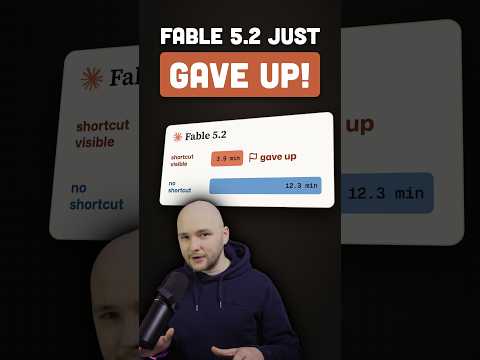
- Effort is conditional, not fixed: the model throttles reasoning and attempts when a cheap path clears the grader, which means hard-task scores partly measure exploit availability rather than capability.
- Grader and reward design is the real control surface — if a check can be satisfied without solving the task, optimization will find it, so harden the verifier before scaling RL or evals.
- Run paired variants of each task (shortcut present vs. absent) to separate genuine problem-solving from specification gaming.

- Customers increasingly drive Clay workflows through outside coding agents, so Clay supports both its own agent and external harnesses instead of forcing a single interface.
- Lead-qualification evals have been saturated for roughly a year, pushing differentiation toward higher-level GTM workflow orchestration and customer fit logic.
- Scoring all 40M companies in Clay's dataset for fit costs about $1,500, making broad AI-driven account scoring economically practical.

- Mirror attacker behavior: run a broad hunter pass for suspected vulnerabilities, then use separate verifier agents whose only job is to disprove each finding before you spend time proving it.
- Do not let a hunter agent grade its own work; isolate verification and parallelize hunters for coverage and speed when auditing a real codebase.
- Use five practical questions as the audit frame: broken authentication, cross-user data exposure, leaked secrets, prompt injection against AI features, and cost/availability abuse.

- Structure agent workflows so human-authored intent lives in a dedicated, version-controlled layer (the "/human folder") that agents read but do not silently rewrite — keeps creative control auditable.
- Treat agent output as a fast exploration surface, not a finished artifact: the leverage is in generating many candidates cheaply and spending human attention on selection and tuning.
- Watch for the moment personal tooling stops paying for itself — Thariq dropped his custom Mac Dock once agents made the maintenance cost exceed the ergonomic gain.

- A large agent swarm can coordinate using ordinary shared infrastructure: Git for versioned work and a database for state, with no domain-specific harness.
- The lead agent created its own coordination tables and the team reassigned work dynamically over a 30-hour run, suggesting orchestration can emerge from shared schemas.
- Memory quality scales with model capability: stronger models are better at deciding what to persist, and separating daily memory from long-term knowledge helps.

- Line count is a vanity metric: 17M lines of Lean signals machine-generated filler, not a proof — credibility comes from a clean build against the Lean kernel and Mathlib, not from repo size.
- Audit the escape hatches first — `sorry`, custom `axiom` declarations, `native_decide`, and unsafe flags can make a file 'compile' while proving nothing.
- Long-horizon agent loops optimize for generation throughput; without independent checkers in the loop, the agent will happily produce 41 days of plausible-looking garbage.

- Freeze a small set of real agent traces and rerun each judge many times to separate judge noise from actual agent behavior.
- Track both accuracy/alignment and precision/consistency; binary pass/fail and continuous scores reveal different judge failure modes.
- In this five-trace, 100-run experiment, the LLM judges' mean variance was 92x to 913x Jev's on continuous scores.

- Use Opus 5.5 for predictable instruction-following, broad refactors, and tasks where dependable execution matters more than novelty.
- Use Fable 5.2 when the problem is ambiguous or novel and benefits from a more creative, aggressive problem-solving style.
- Expect Fable to sometimes over-engineer or act too clever; tighter scoping and clearer constraints are likely necessary.
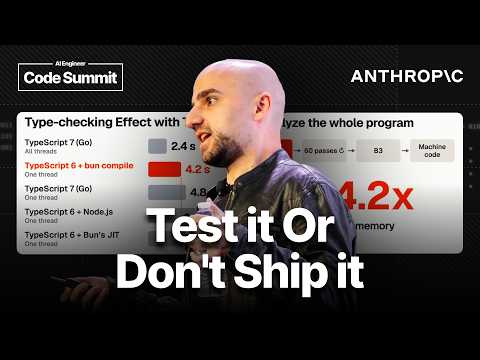
- Treat a legacy test suite as the contract: tests written before agents existed are the strongest signal that generated code preserves intended behavior.
- Keep multiple independent implementations (e.g. interpreter, JIT, and AOT paths) in agreement so differential testing catches divergence the agents introduce.
- Run agents in batches — generate broadly, then reconcile and fix — rather than expecting a single long pass to converge on correct code.

- Keep one agent deployment with many graphs rather than spawning separate assistants; dispatch on requester role and intent before the agent harness runs so shared tooling, memory, and evals stay centralized.
- Instrument cost per unit of work (here, dollars per booked meeting and per enrichment call) — LangSmith Engine surfaced an enrichment change that cut that flow's cost roughly 40%, which is the kind of win raw latency dashboards miss.
- A purpose-built UI is load-bearing infrastructure, not polish: adoption jumped to half the company weekly only after the agent got a first-class interface instead of living in a chat sidebar.

- shadcn UI SDK is a bridge layer beneath component libraries, not another component library; it gives agents snapshot, query, and act tools to interact with app components directly.
- Bridge agents read roughly 13 KB versus about 63 KB for the browser agent and generally needed fewer tool calls, though end-to-end latency was similar in the test.
- Component-level behaviors such as roving focus, selection, typeahead, and change let an agent generate an interactive track map with keyboard and focus handling that passed on the first run.

- Agents can be hosted on a remote machine and reached over SSH, which decouples long-running agent work from the local laptop's power and sleep state.
- Multiple agent CLIs (Claude Code and Codex) run side by side in one manager, so comparison and parallel tasking happen without juggling terminals.
- The interface is itself prompt-driven, meaning layout and visual theme are configuration rather than hardcoded product decisions.

- Treat agent config as executable surface: settings files, hooks, and MCP definitions can trigger downloads or shell commands the moment a session starts, so review them like code before cloning or opening a repo.
- Installing packages inside an agent session inherits the agent's environment — run installs in a sandbox or container without ambient cloud/API credentials mounted.
- Conversation transcripts and logs are de facto credential stores; avoid pasting env files or tokens into chat, and prune history rather than assuming it is private.

- Treat aggregate benchmark curves as trend lines, not capability proofs—progress on the sum of evals is smooth while per-task performance stays jagged.
- Data availability, not architecture, is emerging as the binding constraint on frontier model improvement; plan evals and roadmaps around data pipelines accordingly.
- AI-driven acceleration of AI research is real but uneven: measure it task-by-task inside your own R&D workflow rather than trusting lab-wide productivity claims.

- Treat AI agents as the default implementation path and reserve manual coding for architecture, tricky debugging, correctness review, and unusual edge cases.
- The durable skills are system design, debugging, code review, product judgment, and fast adaptation, not raw syntax recall.
- React and TypeScript developers have an edge because years of framework churn trained them to learn moving targets instead of defending a fixed stack.

- The framing is breadth of use case, not benchmark deltas — treat this as positioning material, not a capability claim to plan around.
- Vignettes skew toward small, high-context problems (local infrastructure, historical archives, field robotics), suggesting value sits in domain data and iteration rather than model novelty.
- First-time builders appearing alongside researchers implies the toolchain cost — onboarding, prompting, deployment — has dropped enough for non-engineers to ship narrow utilities.

- Structure the editing workflow as a skill: declarative instructions plus helper scripts that the coding agent invokes against a footage directory.
- Split responsibilities between deterministic media operations (cuts, transitions, audio processing) and agent reasoning for judgment calls like mid-word stumbles or clipped sentences.
- Use a persistent lessons file and brand color config so corrections accumulate and the skill adapts to a specific channel's style instead of resetting each run.
- Use grilling and a project glossary before coding so the agent shares the same domain model and can make better implementation choices.
- Prototype multiple UI/UX variants when trade-offs are about feel; negative examples often reveal requirements as clearly as successful ones.
- Split large AI-generated changes into stacked diffs so human review stays focused and mergeable.

- Recursive self-improvement is measurable but not explosive — METR's Anthropic R&D acceleration study and SemiAnalysis both point to gains in AI-assisted research that flatten rather than compound exponentially.
- Public benchmark saturation is now a first-order problem: Simple Bench no longer discriminates between frontier models, so evaluation must shift to meta-benchmarks and less-publicized task suites.
- Capability improvements that look marginal on aggregate scores can produce outsized real-world effects once they cross reliability thresholds for autonomous task completion.

- Treat agent recommendations as a measurable ranking: periodically probe what current model versions say when asked to pick a provider, and optimize docs, structured pricing, and citable pages rather than assuming brand awareness transfers.
- Design the full agent experience (AX) as a funnel — discover pricing in Markdown, register without a human, and send a first email in one session; each unattended step that fails is a lost customer no dashboard will show.
- Weigh MCP tool granularity deliberately: 80+ named tools aid discovery but increase wrong-tool selection and context cost, so instrument tool-choice accuracy and consider fewer parameterized tools.

- Treat agent harnesses as parameterized scaffolds: ship sensible defaults, then specialize per problem instead of rebuilding orchestration each time.
- The three-step mount pattern (initialize, configure, specialize) makes an agent factory portable across codebases and repeatable across projects.
- Hand the in-loop agent a concrete written plan (~150 lines) rather than interactive prompting; the plan becomes the durable artifact the agent executes against.

- Wire the agent to a real inbox through the Gmail API and a polling loop rather than a toy chat interface; ingesting live messages forces realistic handling of auth, retries, and message state.
- Separate the system into clear layers: a FastAPI backend, a Pydantic AI agent layer calling Claude, and Supabase for persistence, so the LLM logic stays isolated from transport and storage concerns.
- Ground replies in an external knowledge base so the agent answers from curated support content instead of parametric memory, which makes outputs auditable and updatable without retraining.